Most new businesses don’t fail in a dramatic way. They quietly stop, usually within a few weeks, at a moment that was easy to see coming: the first slow week, a doubtful comment from family, a technical problem nobody planned for.
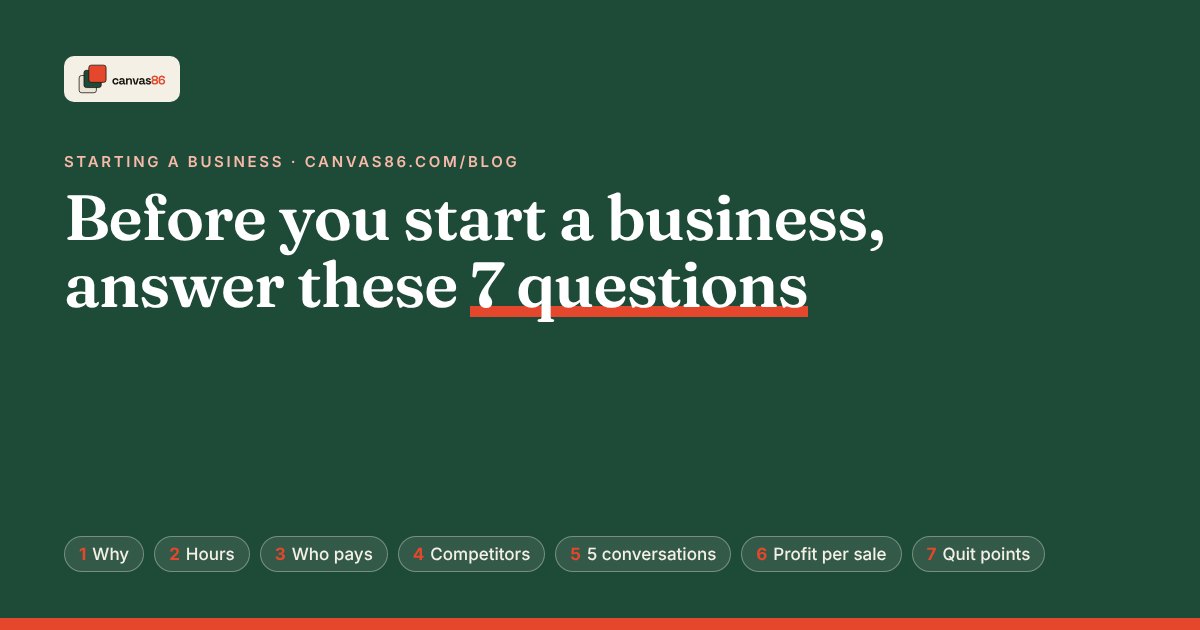
The good news is that most of those moments can be predicted. Answer these seven questions honestly before you spend money, quit a job or build anything, and you’ll know whether your idea is ready, needs testing, or should wait.
1. Why are you really doing this?
Finish this sentence: “I want to start a business because…” Then ask “why?” two more times, and write down the third answer.
If the honest answer is “because I watched someone do it,” that’s not a reason. It’s a feeling, and feelings fade in two or three weeks. A reason that lasts sounds more like: “I want to stop trading every hour of my week for a salary, and I want something I own in 3 years.”
Red flag: the only trigger was a video or a post.
2. How many hours a week can you actually give it?
Not “evenings and weekends.” Real hours, after work, family and sleep. Then name the slots: Tuesday and Thursday 9–10:30 pm, Saturday 8–11 am.
Under five hours a week, progress is so slow it feels like failure, and that feeling is what makes people quit.
3. Who exactly will pay you?
“Everyone” can’t be found, can’t be messaged and doesn’t recognize themselves in your offer. One specific person can.
Describe one customer: their job, their situation, where they spend time, and the moment the problem hurts most. Then check: can you name three real people who fit that description?
4. Who is already selling to them?
No competitors usually means no market, not a gap. Find three businesses already selling to your customer. Note what they charge, how many reviews they have, and what their 1–3 star reviews complain about. Every repeated complaint is an opening for you.
5. Have you talked to five real customers?
Five short conversations will teach you more than five weeks of research. Ask about their past, not your idea: “When did you last deal with this? What did you try? What did it cost you?” People are polite about ideas and honest about what they’ve actually done.
The strongest signal isn’t “I’d buy that.” It’s someone paying, even a small deposit, before the product exists.
6. What’s your profit per sale, and how many sales do you need?
Price minus every cost: materials, platform fees, payment processing, shipping, packaging, refunds. Then work backwards:
A $25 product that costs $9 to deliver makes $16 profit. To earn $800 a month you need 50 sales, about 13 a week.
Now the real question is clear: where will 13 buyers a week come from? If you can’t answer that, you don’t have a plan yet. You have a hope.
7. What will you do when you want to quit?
Write your answers now, while you’re motivated:
- It’s week 3 and you have zero sales. What’s the one thing you’ll change?
- Someone close says “this won’t work.” What’s your answer?
- A shinier idea shows up. What’s your rule?
- At day 90, what number means continue, and what number means stop?
People who decide this in advance treat a bad week as data. People who don’t treat it as a sign.
Add it up: stop, test or go
- Clear answers to most of these: go. Start small this week.
- Gaps in 3–5 of them: test. Don’t build or spend yet. Fix the gaps and run one small test with real people.
- Gaps in most of them: stop, for now. That’s a good result. It just saved you months and money.
Want the full version?
These seven questions come from Before You Start, our 62-question clarity kit. It scores your answers automatically, gives you a Stop, Test or Go verdict and your Founder Type, and builds a personal report and a 30-day plan from your answers. Every red flag comes with a step-by-step fix.
Canvas86
Want a second pair of eyes on your website or idea?
Get a free review of your website and Google listing, or check your business idea with Before You Start.